

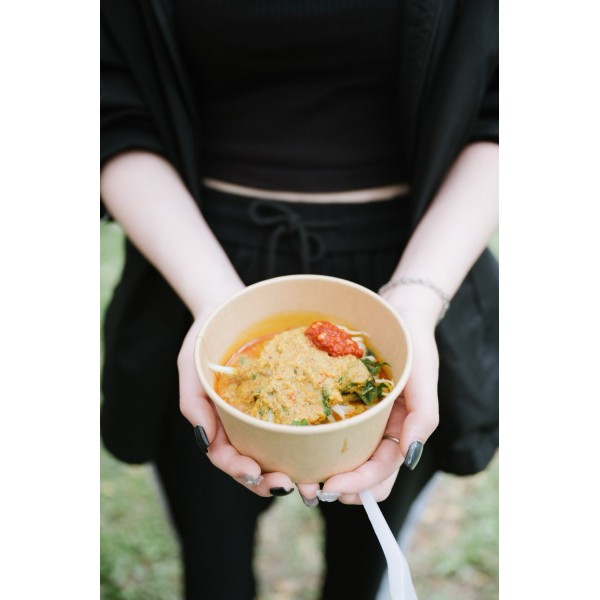

Whenever Laksa is mentioned, most Singaporeans would generally picture an orange-yellow-coloured spicy soup stock, flavoured with coconut milk and dried shrimp with toppings such as cockles, prawns and fishcake. Yet there is another lesser known type of laksa, a dish which is rooted in the Malay community of Singapore: Laksa Siglap or Laksa Cap (pronounced chap).
As the name suggests, this dish originates from the coastal region of Singapore which was Kampung Siglap. As that area has an abundance of fishes and coconut trees, the villagers would use these ingredients as the base of the laksa gravy. Ikan Parang (Wolf Herring), a notoriously bony fish, would be boiled, deboned and be made into a thick fish paste. It would be mixed with kerisik ( a toasted coconut paste) and various other herbs to make the thick and savoury fish-based gravy.
As for the noodle, it is unique in and of itself. It is formed by making a dough from rice flour and sago starch and extracting it through a brass noodle press called a gebak laksa. The extracted noodles is then divided and placed in neat piles as if it has been stamped or in malay "cap", hence its alternate name Laksa Cap.
Laksa Siglap is more than a bowl of noodles, it offers a taste of Singapore’s Malay heritage and preserves the story of the coastal community from which it emerged. By continuing to prepare and serve this lesser known dish, we hope to honour its roots by giving a chance for the next generation of Singaporeans to taste its unique and distinctive flavour.
